Specialty — Solvent Recovery
SP-PV Series — Pervaporation Membranes
Zeolite hollow fibre molecular sieve membranes for solvent dehydration
Product description
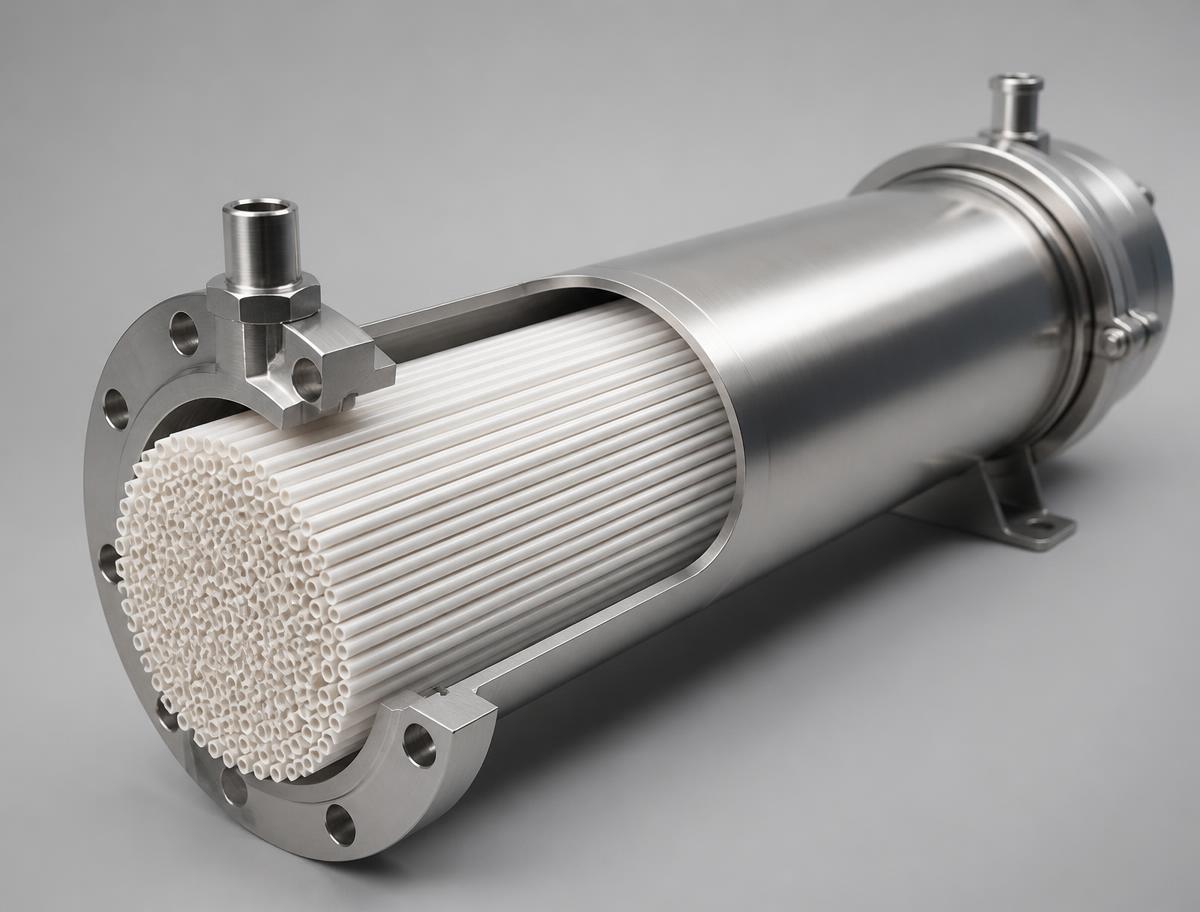
The pervaporation membrane is a high-performance separation material based on a hollow fibre molecular sieve structure. A dense zeolite membrane layer approximately 10 μm thick is grown in situ on the surface of a ceramic hollow fibre support, and multiple hollow fibres are assembled into a single module through integrated encapsulation.
The product offers high flux, excellent selectivity and outstanding energy efficiency, performing particularly well in organic solvent dehydration and separation as an efficient alternative to conventional distillation.
Working principle: driven by vacuum or concentration difference, specific components are preferentially adsorbed by the molecular sieve membrane and diffuse through the membrane pores, where they are released in vapour form. The hollow fibre structure shortens the mass transfer path and reduces resistance, giving higher permeation flux and improved separation efficiency.
Specifications
| Item | Parameter |
|---|---|
| Energy Saving | ≥50% versus conventional separation technologies |
| Single-Pass Recovery | ≥99% |
| Service Life | ≥5 years |
| Membrane Structure | Hollow fibre with thin wall and low mass transfer resistance |
| Permeation Flux | 2–3 times higher than tubular molecular sieve membranes |
| Packing Density | ≥200 m²/m³ (over 3× tubular molecular sieve membranes) |
| Sealing Technology | One-piece encapsulation, no O-ring required |
| Effluent Quality | Wastewater COD < 5,000 |
Performance figures are nominal values obtained under the standard test conditions stated with each table. Actual performance varies with feedwater chemistry, pretreatment, flux, recovery, temperature, pressure and operating practice. Individual element flow may vary from the nominal value. Specifications are subject to change without notice — request the current datasheet before specifying.
Typical applications
- Alcohol systems — dehydration of methanol, ethanol, isopropanol, tert-butanol
- Ether systems — dimethoxyethane, MTBE, ETBE and related compounds
- Ketone systems — acetone, butanone (MEK), methyl isobutyl ketone (MIBK)
- Ester systems — methyl acetate, ethyl acetate, butyl acetate, ethylene carbonate
- Hydrocarbon systems — methane, ethane and C6 fractions
- Aromatic compounds — benzene, toluene and similar systems
- Other organic systems — tetrahydrofuran (THF), acetonitrile and more
Related series
Need a datasheet or pilot support?
Share your feedwater analysis and target recovery — our engineers will recommend the right element and array configuration.