Specialty — Gas Separation
SP-VOC Series — VOCs Recovery Membranes
Rubbery polymer membranes separating organic vapours from light gases
Product description
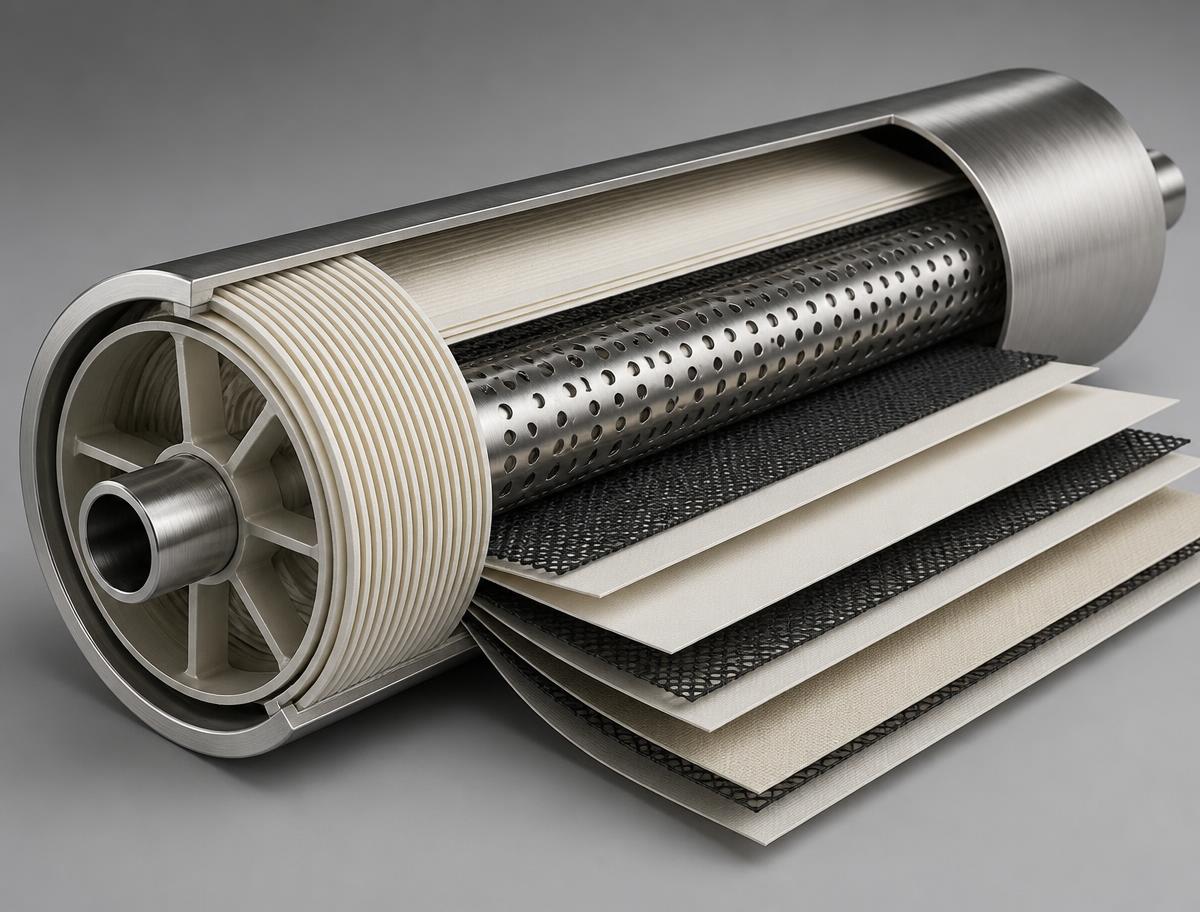
The VOCs Recovery Membrane is a high-efficiency gas separation system using rubbery polymer membrane technology that effectively separates organic vapours (VOCs) from light gas components. The compact membrane system is easy to operate and suits chemical, petrochemical and gas processing industries.
Working principle: separation is based on selective solubility. Heavier, higher-boiling molecules such as ethylene, propylene, chloromethane, vinyl chloride, butadiene and other light hydrocarbons dissolve easily in the membrane and permeate quickly, while lighter, lower-boiling gases such as H₂, N₂ and CH₄ permeate more slowly. Under the pressure differential the gas stream separates into a permeate enriched in organic vapours and a retentate of purified light components.
Membrane modules are available in spiral-wound and stacked configurations to suit different processing needs.
Specifications
| Process | Capacity | Power | Recovery Rate | Standard Compliance |
|---|---|---|---|---|
| Absorption–Adsorption Process | 600 Nm³/h | 60 kW | 75% | Difficult |
| Cryogenic–Adsorption Process | 600 Nm³/h | 120 kW | 85% | Unstable |
| Membrane Gradient Coupling Process | 600 Nm³/h | 109 kW | 95% | Stable |
Performance figures are nominal values obtained under the standard test conditions stated with each table. Actual performance varies with feedwater chemistry, pretreatment, flux, recovery, temperature, pressure and operating practice. Individual element flow may vary from the nominal value. Specifications are subject to change without notice — request the current datasheet before specifying.
Typical applications
- Recovery of propylene monomer from polypropylene vent gas
- Recovery of propylene derivatives (acrylonitrile, butanol, propylene oxide)
- Recovery of ethylene, butene, pentane and hexane from polyethylene vent gas
- Recovery of ethylene derivatives (ethylene oxide, ethylene glycol, PVC)
- Recovery of chloromethane monomers in siloxane quaternary ammonium salt production
- Recovery of light hydrocarbons from catalytic reforming off-gas and refinery gases
- Recovery of tail gas during loading and unloading at stations and terminals
- Gas recovery at gas stations and gasoline storage tanks
- Natural gas dew point reduction and treatment
Related series
Need a datasheet or pilot support?
Share your feedwater analysis and target recovery — our engineers will recommend the right element and array configuration.