Textile dyeing & printing · Water reuse
NF stage upgrade removes the bottleneck in a UF–NF–RO reuse train
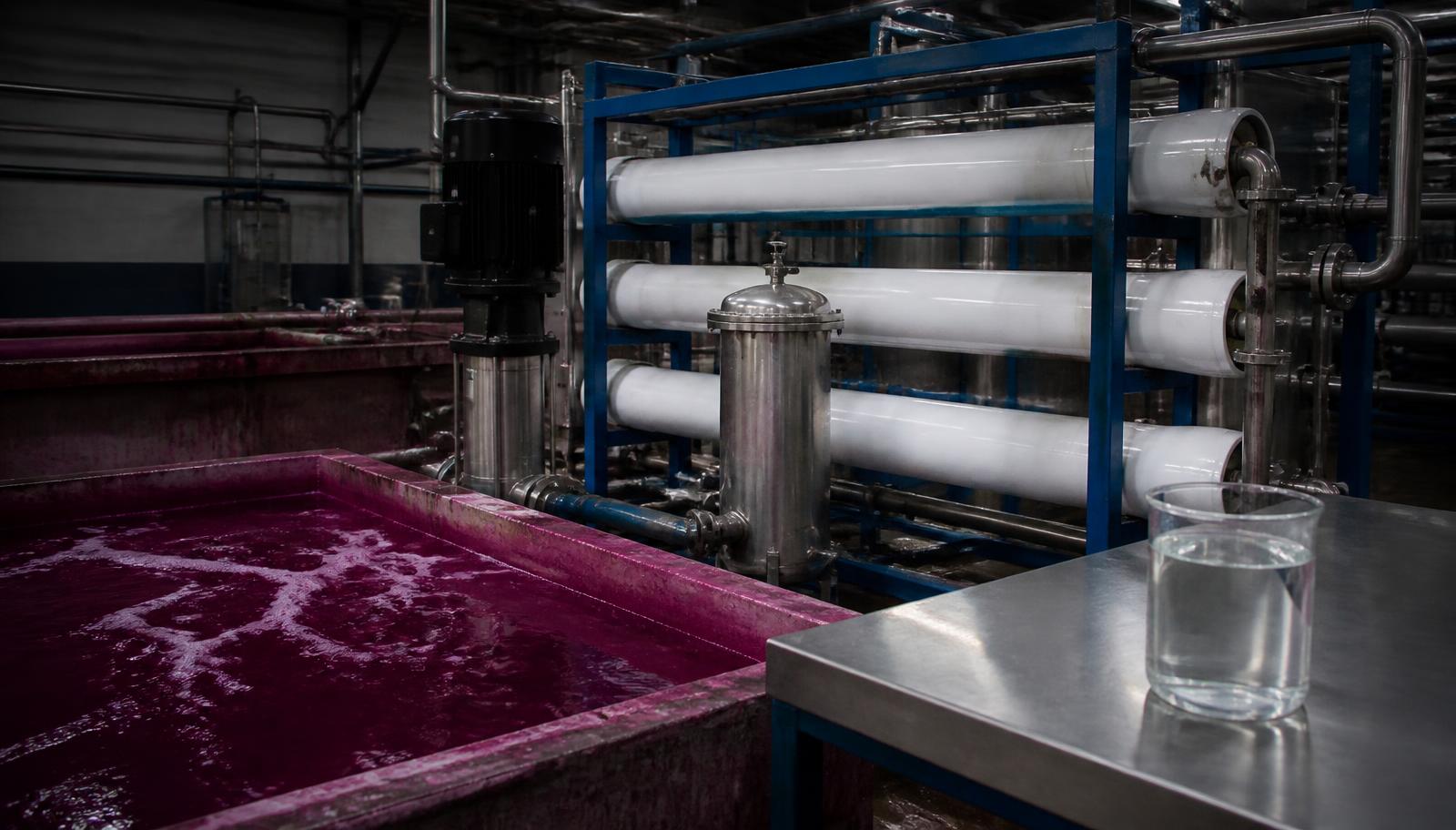
An advanced membrane ETP integrating UF, NF and RO to recycle textile dyeing and printing wastewater — with the NF stage limiting the whole train.
- Client
- Amul Enterprise — AMUL Print
- Location
- Jetpur, Gujarat, India
- Product
- SV-NanoMetrix™ NF-9 (150–300 Da)
- Period
- Retrofit, identical operating conditions
Client-ready summary with charts and plant data tables.
~97%
Hardness reduction
>99%
Colour & TSS removal
55% → 70%
Recovery rate
~40%
OPEX reduction
Background
AMUL Print operates a membrane-based effluent treatment plant integrating ultrafiltration, nanofiltration and reverse osmosis to recycle wastewater for process reuse.
The plant previously used conventional imported SFNF membranes. To improve permeate quality, unload the downstream RO and improve overall efficiency, the NF stage was upgraded to SV-NanoMetrix™ NF-9.
The challenge
- High dissolved salts, hardness, colour bodies and organics caused persistent NF fouling.
- Frequent chemical cleaning, repeated shutdowns and accelerated membrane wear raised operating expense.
- Unstable NF permeate quality loaded the downstream RO and blocked progress toward ZLD.
The solution
SVJPL audited the UF–NF–RO train and identified nanofiltration as the limiting stage. The existing elements were replaced with SV-NanoMetrix™ NF-9 (150–300 Da) membranes, selected for higher rejection and improved fouling resistance.
The elements were fully compatible with existing housings, so the retrofit was completed with no mechanical modification and minimal downtime under SVJPL supervision.
Results & plant data
| Category | Parameter | Feed | Permeate | Rejection / remark |
|---|---|---|---|---|
| Hydraulics | Flow rate | 42 m³/hr | 24 m³/hr | 18 m³/hr brine |
| Recovery | — | ~57–60% | Stable operation | |
| Operating pressure | 19 bar | — | Energy optimised | |
| Dissolved solids | TDS (ppm) | 18,000 | 3,000 | ~83% reduction |
| Hardness | Hardness (ppm) | 11,000 | 330 | ~97% reduction |
| Ions | Chloride (ppm) | 5,100 | 400 | ~92% reduction |
| Suspended solids | TSS (ppm) | 180 | < 1 | > 99% removal |
| Colour | Colour (Pt-Co) | 9,000 | < 75 | > 99% removal |
| Metric | Before | After |
|---|---|---|
| ΔP rise rate | 0.25 bar/day | 0.07 bar/day (~3.6× slower) |
| CIP frequency | Every 48 hours | Every 7 days (~71% fewer) |
| Recovery rate | 55% | 70% |
| Specific energy consumption | Baseline | ~20% lower |
| Operating cost | Baseline | ~40% lower |
| Return on investment | — | Within 5 months |
Operational impact
- ~650 additional productive operating hours per year.
- Lower downstream RO load and more consistent permeate TDS.
- 50% lower cleaning frequency across the recovery system.
- Stable, high-quality permeate for dependable industrial reuse.
Upgrading a single stage transformed the whole train: 75–95% reduction in dissolved salts and hardness, >99% removal of colour and suspended solids, halved cleaning frequency and over 40% operating cost savings.
More case studies
Textile CETP · ZLD
150 MLD textile CETP — one RO train retrofitted to HDG, flow stabilised
Gujarat Eco Textile Park (GETP)
Starch & food processing · Water reuse
Starch ETP RO retrofit: 3.6× slower fouling, ROI under 5 months
Everest Starch India Pvt. Ltd.
Textile CETP · Caustic purification, colour & starch removal
Hollow fiber NF purifies waste caustic, removing colour and starch
Common Effluent Treatment Plant, Jetpur
Want this result on your plant?
Send your feedwater analysis, array configuration and cleaning history — we will model the duty and propose a side-by-side trial.