Textile CETP · ZLD
150 MLD textile CETP — one RO train retrofitted to HDG, flow stabilised
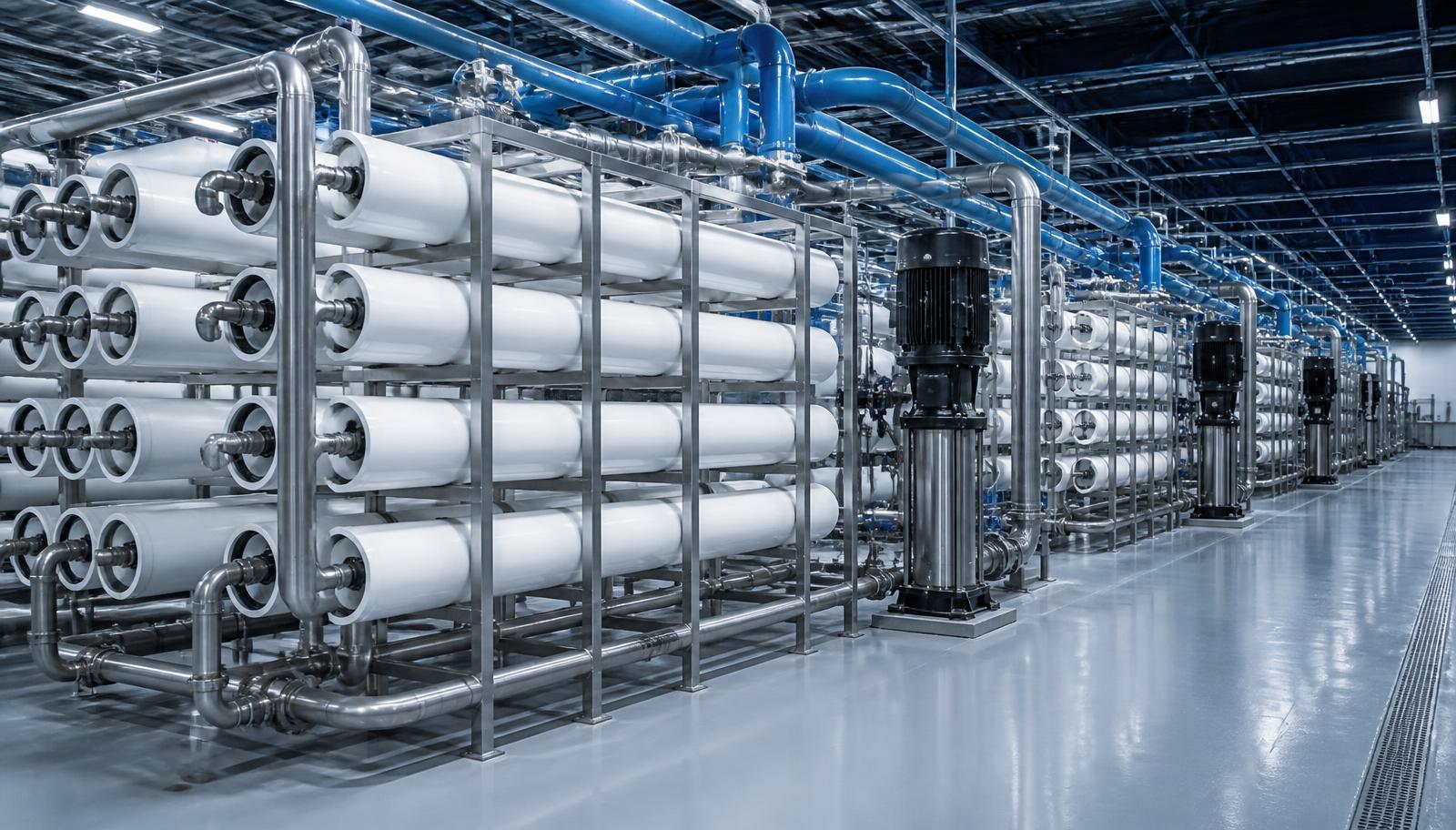
A 150 MLD CETP treating high-COD textile effluent from 30+ dyeing, printing and technical textile units and recycling 25 MLD — running to a Zero Liquid Discharge mandate.
- Client
- Gujarat Eco Textile Park (GETP)
- Location
- Palsana, Surat, Gujarat, India
- Product
- SV-NanoMetrix™ FR8040-355LD (HDG)
- Period
- March–April 2026
Client-ready summary with charts and plant data tables.
165 m³/hr
Stabilised permeate flow (per train)
50%
CIP frequency reduction
95.0%
System availability
138%
5-year ROI
Background
Gujarat Eco Textile Park in Surat spans 104 acres and hosts more than 30 operational units across dyeing, printing and technical textiles. Its 150 MLD Common Effluent Treatment Plant treats the cluster's effluent and recycles 25 MLD, the backbone of the park's Zero Liquid Discharge commitment.
The recycle stream passes through an RO system of 10 trains, each holding 350 elements — 3,500 in total. Until this trial every train ran conventional 400 sq. ft. FR membranes on a narrow feed channel, marketed as fouling-resistant but unable to hold up against the aggressive organic, colloidal and dye load of textile effluent.
SV-NanoMetrix™ replaced the elements in one train with the FR8040-355LD model using HDG — Hydrodynamic Channel Geometrics — and ran it under identical operating conditions against the nine unchanged trains.
The challenge
- Product flow collapsed from 200 m³/hr to 140 m³/hr within the first 24 hours of operation.
- Flow continued declining to 100–110 m³/hr just 48 hours after each cleaning — no stable operating window.
- Clean-In-Place was required every 48 hours: 182 CIP events, 944 hours of downtime and ₹28.5 lakhs of annual operating expenditure.
- Accelerated element degradation and chemical consumption made the ZLD target economically unsustainable.
The solution
SV-NanoMetrix™ supplied FR8040-355LD elements engineered specifically for extreme, high-fouling industrial duty. The performance gap is architectural, not incremental: HDG open-channel geometry raises cross-flow shear and lowers pressure drop, while Thermo-FR™ surface chemistry keeps organic dyes, surfactants and biofoulants from adsorbing to the active layer in the first place.
The changeover used the existing pressure vessels and array — no mechanical modification, no process redesign — and was commissioned under SVJPL technical supervision.
Engineering features
- Thermo-FR™ Surface Shield — hydrophilic, near-neutral surface that resists dye and biological attachment.
- HDG — Hydrodynamic Channel Geometrics: open, symmetric feed channel for stable shear, lower ΔP and lower concentration polarization.
- Selective Layer Architecture tuned for 99.5–99.7% NaCl rejection at high-fouling feed conditions.
- Continuous pH 2.0–12.0 tolerance with CIP down to pH 1.0 and up to pH 13.0.
Results & plant data
Flux decline vs operating time
| Parameter | Before | After | Improvement |
|---|---|---|---|
| CIP frequency | Every 48 hours | Every 96 hours | 50% reduction |
| Product flow (24 h) | 140 m³/hr | 165 m³/hr | +18% |
| Product flow (48 h) | 100–110 m³/hr | 165 m³/hr | +50% |
| Flow stability | Declined continuously | Constant at 165 m³/hr | Fully stabilised |
| Recovery rate | 75% | 75% | Consistent |
| Feed pressure | 17 bar | 17 bar | Stable, no pressure creep |
| Specification | SV-NanoMetrix™ FR8040-355LD (HDG) | Conventional 400 sq. ft. FR | Advantage |
|---|---|---|---|
| Membrane type | TFC polyamide (NanoMatrix™ surface) | TFC polyamide (standard FR) | Enhanced surface |
| Feed channel | HDG open channel (low differential) | Conventional narrow channel | Wider, higher-shear channel |
| Active area | 355 ft² (33 m²) | 400 ft² (37.2 m²) | Optimised for fouling resistance |
| NaCl rejection | 99.5–99.7% | 99.0–99.5% | +0.2–0.5% |
| Max operating pressure | 600 psi (41 bar) | 600 psi (41 bar) | Equivalent |
| pH range (continuous) | 2.0 – 12.0 | 2.0 – 11.0 | Wider pH tolerance |
| Feed NTU tolerance | < 5 NTU | < 1 NTU | 5× higher tolerance |
| Concentration polarization | Low (HDG geometry) | Moderate | Reduced fouling |
| Typical CIP interval | 96 hours | 48 hours | 2× longer |
| Flow stability (48 h) | 165 m³/hr constant | 100–110 m³/hr declining | +50% higher |
| Feed turbidity (NTU) | SV-NanoMetrix™ ΔP (bar) | Conventional 400 sq. ft. FR ΔP (bar) |
|---|---|---|
| 0 | 0.5 | 0.5 |
| 2 | 1.0 | 1.5 |
| 4 | 1.8 | 3.0 |
| 6 | 2.5 | 5.0 |
Salt rejection stayed above 99% up to 6 bar differential pressure, while the conventional element dropped below 98% under identical conditions.
| Metric | Conventional 400 sq. ft. FR | SV-NanoMetrix™ FR8040-355LD (HDG) |
|---|---|---|
| CIP events per year | 182 | 91 |
| Downtime (hours/year) | 728 | 364 |
| CIP chemical cost (₹ lakhs) | 18 | 9 |
| System availability | 89.2% | 95.0% |
| Recovered productive time | — | 508 hours/year |
| Year | Conventional 400 sq. ft. FR | SV-NanoMetrix™ |
|---|---|---|
| 0 | 42.0 | 36.0 |
| 1 | 56.0 | 56.0 |
| 2 | 93.0 | 73.0 |
| 3 | 121.0 | 89.0 |
Five-year net saving exceeds ₹55 lakhs with a 138% return on investment.
Operational impact
- Downtime halved — CIP interval doubled from 48 to 96 hours, recovering 508 productive hours per year.
- Recovery held at 75%, directly supporting the park's ZLD balance.
- Feed pressure stable at 17 bar with no pressure creep, protecting specific energy consumption.
- Slower fouling rate through HDG geometry, expected to significantly extend element service life.
- Reliable 150 MLD operation for the entire textile cluster.
By eliminating the drastic first-48-hour flow decline, the plant now runs at a constant 165 m³/hr permeate flow with half the cleaning burden and unchanged 75% recovery — a dependable hydraulic foundation for the park's Zero Liquid Discharge programme.
More case studies
Starch & food processing · Water reuse
Starch ETP RO retrofit: 3.6× slower fouling, ROI under 5 months
Everest Starch India Pvt. Ltd.
Textile dyeing & printing · Water reuse
NF stage upgrade removes the bottleneck in a UF–NF–RO reuse train
Amul Enterprise — AMUL Print
Textile CETP · Caustic purification, colour & starch removal
Hollow fiber NF purifies waste caustic, removing colour and starch
Common Effluent Treatment Plant, Jetpur
Want this result on your plant?
Send your feedwater analysis, array configuration and cleaning history — we will model the duty and propose a side-by-side trial.