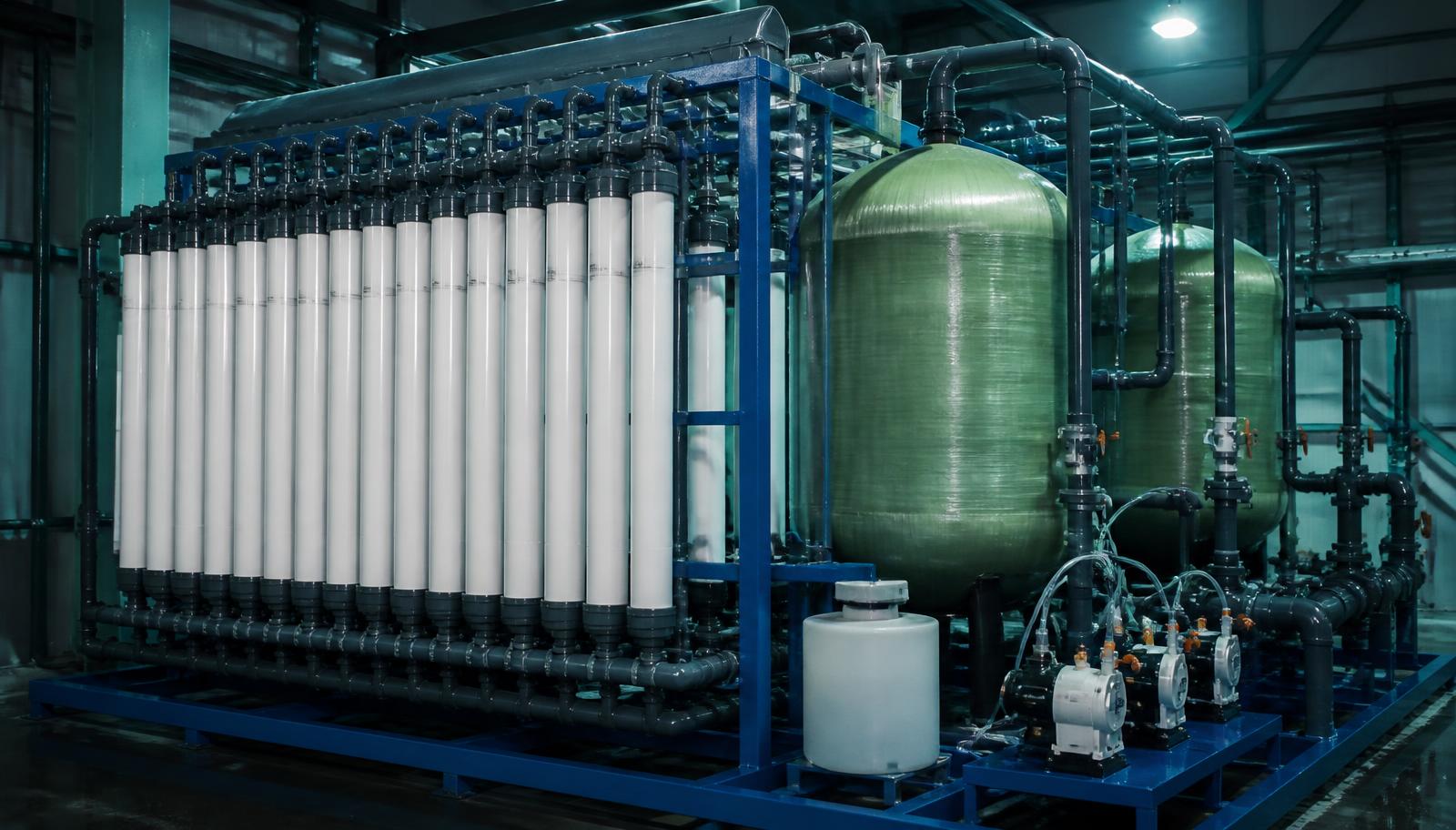
Textile CETP · Caustic purification, colour & starch removal
Hollow fiber NF purifies waste caustic, removing colour and starch
Spent caustic from water-intensive textile industries — normally neutralised and discharged as waste — is purified and decolourised so it can be returned to process.
- Client
- Common Effluent Treatment Plant, Jetpur
- Location
- Jetpur, Gujarat, India
- Product
- SV-NanoMetrix™ HF~NF-40 hollow fiber nanofiltration
- Period
- Full-scale operation
Client-ready summary with charts and plant data tables.
80%
Waste caustic purified
5 bar
Operating pressure
1,500 m³/d
Treated flow
87%
COD & colour removal
Background
Purifying and decolourising spent caustic offers significant sustainability and cost benefits across process industries, including food, beverage and textiles.
Without a purification route, the spent caustic is discharged as waste and additional chemicals must be dosed to neutralise the stream.
The challenge
- Conventional membranes are not stable at pH above 12.5 in continuous service.
- Discharging spent caustic increases raw chemical purchase, wastewater treatment cost and neutralisation chemical demand.
- Discharge regulations for high-alkalinity effluent continue to tighten.
The solution
HF~NF membranes hold excellent stability at extreme pH, which allows purification and decolourisation of spent caustic in a single filtration step — no dilution, no neutralisation penalty.
For the Jetpur CETP, direct nanofiltration with HF~NF-40 modules purifies more than 80% of the spent caustic stream, returning a clear, colour-free permeate free of contaminants and without loss of alkalinity.
Results & plant data
| Stream | pH | NaOH (%) | COD (ppm) |
|---|---|---|---|
| Feed | > 12.5 | 2.9 | 7,480 |
| Permeate (purified caustic) | > 12.5 | 2.5 | 970 |
| Concentrate | > 12.5 | > 3.0 | 39,680 |
| Parameter | Value |
|---|---|
| Pressure | 5 bar |
| Permeate yield | 80% |
| Flow | 1,500 m³/d |
| Configuration | Direct nanofiltration, single step |
Operational impact
- Purified, colour-free caustic returned to process reduces fresh caustic purchase for the textile cluster.
- Lower treatment cost for caustic wastewater.
- Compliance headroom against increasingly stringent discharge regulation.
- A purification-and-reuse model rather than a treat-and-discharge model.
Direct nanofiltration converts a disposal problem into purified, colour-free caustic: over 80% of the spent caustic stream returns to process as clear, contaminant-free permeate with alkalinity intact.
More case studies
Textile CETP · ZLD
150 MLD textile CETP — one RO train retrofitted to HDG, flow stabilised
Gujarat Eco Textile Park (GETP)
Starch & food processing · Water reuse
Starch ETP RO retrofit: 3.6× slower fouling, ROI under 5 months
Everest Starch India Pvt. Ltd.
Textile dyeing & printing · Water reuse
NF stage upgrade removes the bottleneck in a UF–NF–RO reuse train
Amul Enterprise — AMUL Print
Want this result on your plant?
Send your feedwater analysis, array configuration and cleaning history — we will model the duty and propose a side-by-side trial.