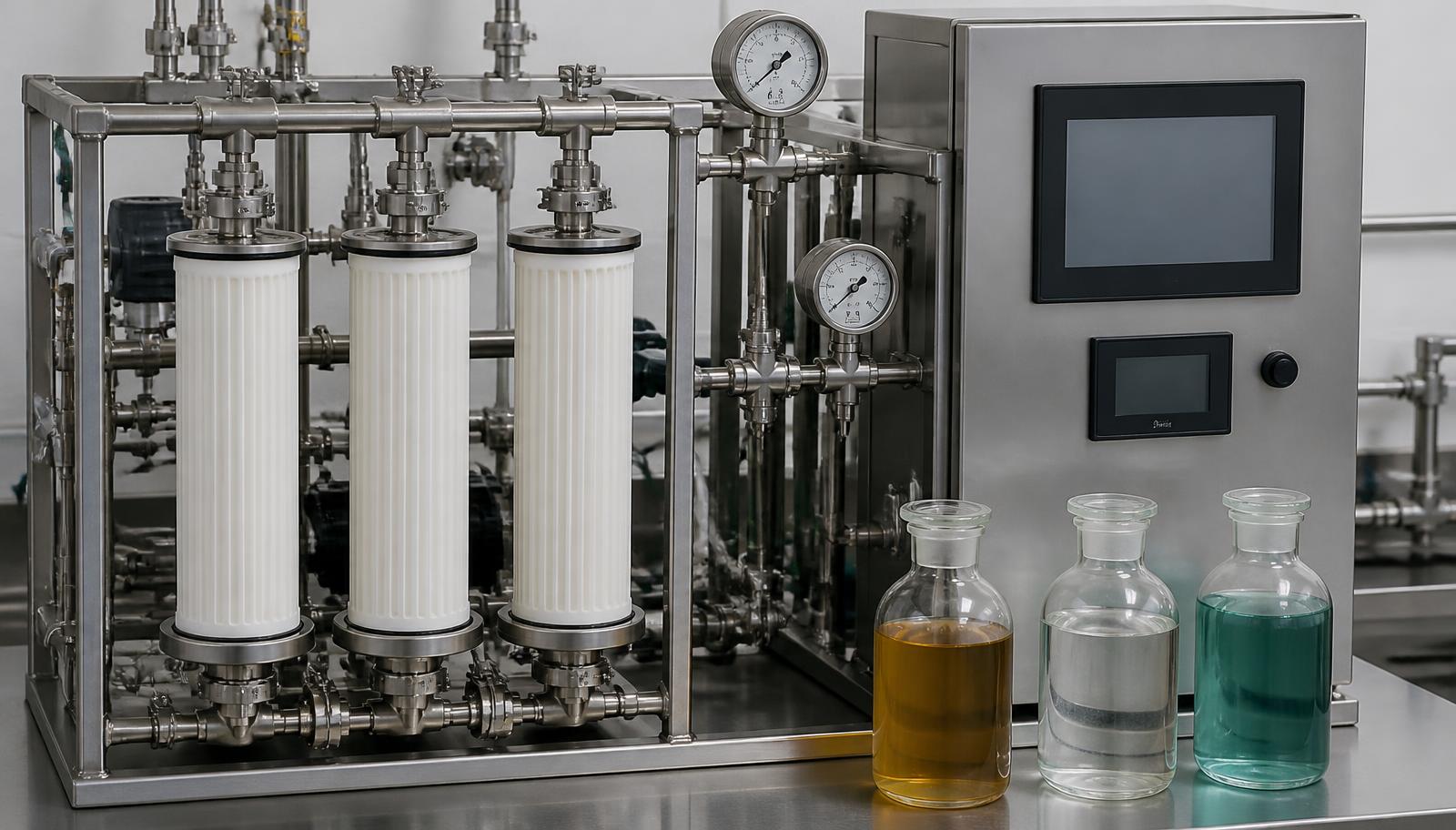
Ceramic UF · Trials & resource recovery
Ceramic membrane trials across six challenging industrial streams
Where polymeric membranes reach their chemical or thermal limit, ceramic elements operate across pH 0–14 and elevated temperature with full regeneration capability.
- Client
- Multiple industrial sites
- Location
- India & international references
- Product
- SV-NanoMetrix™ ceramic membrane elements
- Period
- Trial reference programme
Client-ready summary with charts and plant data tables.
99.56%
Peak turbidity reduction
100%
TSS removal (oil–water)
98.29%
Oil & grease removal
92%
Caustic recovery
Background
SV-NanoMetrix™ ceramic membranes are deployed across water treatment, food and beverage, chemical and pharmaceutical, agrochemical, oil and gas, and aerospace and defence applications.
Typical duties include emulsion and wash-water treatment, digestate filtration, caustic recovery, indigo/leuco dye recovery, produced water, tannery and textile effluent, pyrogen-free water and bilge water.
The challenge
- Streams with high temperature, extreme pH, emulsified oil or heavy colloidal load destroy polymeric elements.
- Disposal volumes and chemical consumption drive both cost and environmental exposure.
- Downstream RO stages need a robust, reliably clarified feed.
The solution
Ceramic UF elements were trialled on real site feeds under representative operating conditions, with feed and permeate analysed side by side for each duty.
Typical operating envelope: 3.3–4 mm channel diameter, UF pore size, 100–250 L/m²h permeate performance, 60–80 °C, 1.5–3 bar TMP and 4–6 m/s channel velocity — with full in-system regeneration.
Results & plant data
| Parameter | Raw feed | Ceramic permeate |
|---|---|---|
| pH | 7.08 | 7.15 |
| Turbidity (NTU) | 26 | < 1 |
| TDS | 89 | 82 |
| Total hardness | 49 | 45 |
96% reduction in turbidity.
| Parameter | Raw feed | Ceramic permeate |
|---|---|---|
| pH | 8.60 | 8.62 |
| Turbidity (NTU) | 47.00 | 2.00 |
| TSS (mg/L) | 98.00 | < 1.00 |
| Chloride (mg/L) | 2,481.50 | 1,885.94 |
| Sulphate (mg/L) | 1,410.00 | 1,321.00 |
| COD (mg/L) | 1,893.30 | 906.00 |
| BOD (mg/L) | 361.00 | 163.00 |
95.7% turbidity reduction and 98.9% TSS reduction.
| Parameter | Raw feed | Ceramic permeate |
|---|---|---|
| Turbidity (NTU) | 23 | 0.44 |
| pH | 6.95 | 7.85 |
| TDS (mg/L) | 87 | 86 |
| Conductivity (µS/cm) | 142 | 140 |
| TSS (mg/L) | 198 | NIL |
| Oil & grease (mg/L) | 999 | 17 |
98.09% turbidity, 100% TSS and 98.29% oil & grease reduction.
| Parameter | Raw feed | Ceramic permeate |
|---|---|---|
| Turbidity (NTU) | 124 | 0.55 |
| TDS (mg/L) | 13,338 | 12,259 |
| pH | 4.23 | 4.27 |
99.56% reduction in turbidity at pH 4.2.
| Parameter | Raw feed | Ceramic permeate |
|---|---|---|
| pH | 8.56 | 8.60 |
| Turbidity (NTU) | 116 | 5.0 |
| Oil & grease (ppm) | 980 | 20.8 |
| TSS (mg/L) | 300 | 5.0 |
95.69% turbidity, 98.33% TSS and 97.88% oil & grease reduction.
| Parameter | Raw feed | Ceramic permeate |
|---|---|---|
| pH | 13.01 | 13.00 |
| TSS (ppm) | 3,375 | Not detected |
| TDS (ppm) | 47,800 | 39,200 |
| Caustic (%) | 2.4 | 2.2 |
100% TSS removal with 92% caustic recovery.
Operational impact
- Reduction of COD, TSS, agglomerates, precipitated metals and emulsified oils.
- Residual disposal volume minimised — direct cost saving.
- High reliability under high temperature and extreme pH, with long service life.
- Constant process stability and low operating cost, with membranes regenerable in place.
Across six independent trial streams, ceramic ultrafiltration delivered consistent clarification and recovery performance in conditions that rule out polymeric membranes entirely — including 92% caustic recovery from a pH 13 waste stream.
More case studies
Textile CETP · ZLD
150 MLD textile CETP — one RO train retrofitted to HDG, flow stabilised
Gujarat Eco Textile Park (GETP)
Starch & food processing · Water reuse
Starch ETP RO retrofit: 3.6× slower fouling, ROI under 5 months
Everest Starch India Pvt. Ltd.
Textile dyeing & printing · Water reuse
NF stage upgrade removes the bottleneck in a UF–NF–RO reuse train
Amul Enterprise — AMUL Print
Want this result on your plant?
Send your feedwater analysis, array configuration and cleaning history — we will model the duty and propose a side-by-side trial.