Starch processing · External MBR
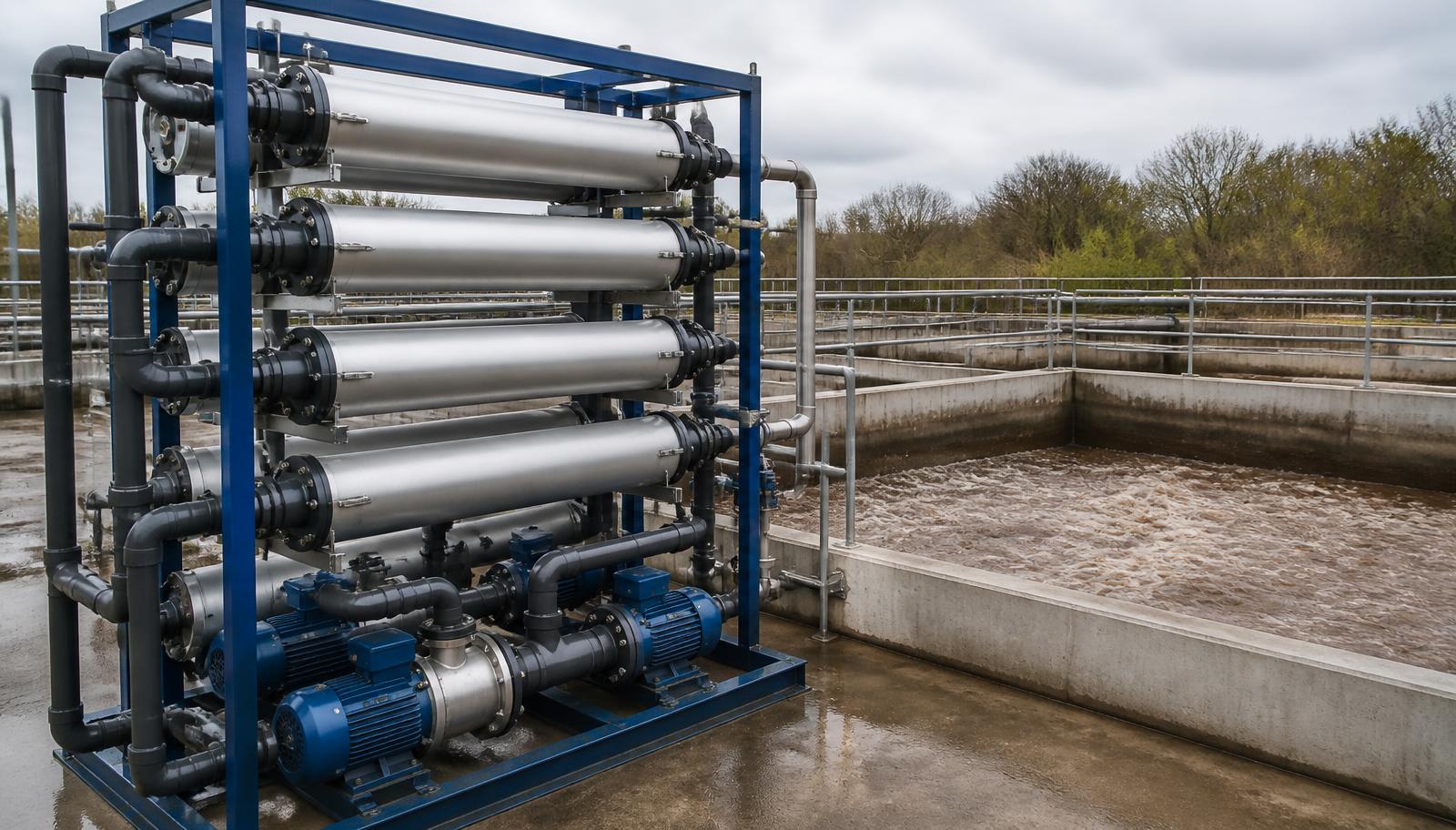
External Spiral UF replaces a failing hollow-fiber MBR at MLSS 15,000
High-strength starch wastewater — COD up to 33,000 mg/L, H₂S present, viscous non-settling sludge — where conventional hollow-fiber MBR simply fails.
- Client
- Everest Starch India Pvt. Ltd.
- Location
- Gujarat 363520, India
- Product
- SV-NanoMetrix™ SP-UF 100 kDa spiral modules
- Period
- 2025
Client-ready summary with charts and plant data tables.
24×7
Continuous stable operation
< 1 mg/L
Permeate TSS
85–95%
Backwash flux recovery
~70%
Less chemical cleaning
Background
The plant treats starch manufacturing effluent with COD up to 33,000 mg/L. A UASB digester reduces COD to 2,200–2,800 mg/L before the aerobic biological stage.
The aeration basin runs at MLSS 12,000–15,000 ppm with SVI 1,800–2,400 — viscous, high-carbohydrate, non-settling sludge.
The challenge
- The hollow-fiber submerged MBR fouled twice per week, with cake-layer compaction from poor SVI.
- Fibers coagulated and jammed together into a solid mass; permeate collapsed within 24–48 hours.
- HF membranes cannot tolerate MLSS of 12,000–15,000 mg/L or SVI above 1,800; H₂S chemically attacked the surface.
- Low cross-flow meant near-zero shear, massive gel layer formation and instant pore choking from colloidal starch organics.
The solution
SVJPL installed an external UF skid with spiral-wound flat-sheet modules on an open feed channel, running velocity-driven cross-flow at 1.5–3.0 m/s. The resulting wall shear prevents solids deposition, cake compaction and — with no fibers in the design — any possibility of fiber coagulation.
Two SP-UF 100 kDa modules operate on a dedicated skid with a common recirculation pump, automated backwash header and optional air-scour line. The skid draws mixed liquor directly from the existing aeration tank, so the biological process and civil infrastructure were left untouched.
Results & plant data
| Parameter | Raw post-UASB | Aeration MLSS | Spiral UF permeate |
|---|---|---|---|
| COD | 2,200–2,800 mg/L | — | 300–450 mg/L |
| BOD | 800–1,200 mg/L | — | 3–6 mg/L |
| TSS | 1,500–2,500 mg/L | 12,000–15,000 mg/L | < 1.0 mg/L |
| Turbidity | > 1,000 NTU | — | 0.50–1.12 NTU |
| Oil & grease | 20–60 mg/L | — | < 1 mg/L |
| Coliform | High | — | 90–95% reduction |
| Performance indicator | HF-MBR (before) | External Spiral UF (after) |
|---|---|---|
| Flux stability | Drops within 24–48 hrs | Stable 7–12 days continuously |
| Cleaning frequency | 2× weekly | 1× in 2–3 weeks |
| Backwash recovery | 10–20% | 85–95% flux recovery |
| Pressure range | 0.3–0.6 bar suction | 0.1–1.2 bar cross-flow |
| Fibre breakage | Frequent | None (no fibres) |
| MLSS handling | Max 8,000 ppm | 12,000–15,000 ppm fully stable |
| SVI limitation | Very sensitive | Works even at SVI 1,800–2,400 |
Operational impact
- Stable 24×7 operation with no fiber coagulation or permeability collapse.
- MBR-grade permeate as a reliable feed to the downstream RO, raising RO recovery.
- Flux recovery after backwash above 90%, allowing long uninterrupted filtration cycles.
- No civil modification — the skid integrated directly with the existing aeration tank.
External Spiral UF proved a more resilient membrane separation step for demanding industrial biology, holding low-turbidity permeate under extreme MLSS, poor SVI and H₂S conditions where hollow-fiber MBR failed weekly.
More case studies
Textile CETP · ZLD
150 MLD textile CETP — one RO train retrofitted to HDG, flow stabilised
Gujarat Eco Textile Park (GETP)
Starch & food processing · Water reuse
Starch ETP RO retrofit: 3.6× slower fouling, ROI under 5 months
Everest Starch India Pvt. Ltd.
Textile dyeing & printing · Water reuse
NF stage upgrade removes the bottleneck in a UF–NF–RO reuse train
Amul Enterprise — AMUL Print
Want this result on your plant?
Send your feedwater analysis, array configuration and cleaning history — we will model the duty and propose a side-by-side trial.